
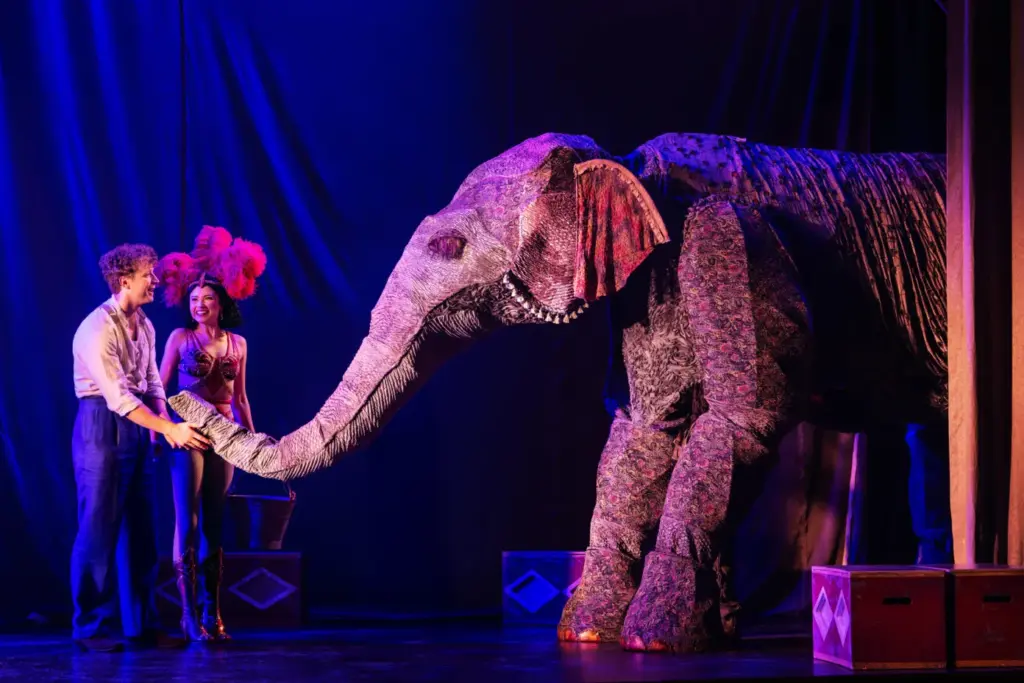
Almost 30 years ago, Julie Taymore created for the Disney Company a play, The Lion King, that transformed the way an audience perceived animals on the stage. Using a combination of Japanese, Balinese, and African puppetry, the puppeteer and animal were one and the same in a visually beautiful transformation. Another production, War Horse in the early 2000s, followed that magical animal interpretation successfully also. Now, in 2026 at the Pantages, Water for Elephants follows in that tradition of puppeteer and animal transforming the musical as the story unfolds of the Benzini Brothers Circus.
Jacob Jankowski (Robert Tully), starts the narrative as an elderly man reminiscing about his youth at the circus. As he begins the tale, the stage becomes populated with circus folk on a train traveling toward their next show. Young Jacob (Zachary Keller), grieving the loss of his parents, aimlessly gets on that train that will change his life forever.
He becomes a roustabout until the ringmaster boss, August (Connor Sullivan), finds out he had vet training and presses him into service for the aging animals. Predictably, Jacob falls in love with Marlena (Helen Krushinski), August’s wife, who is abused by her husband. Though the story is timeworn, the energy of the cast and the music that helms the story creates an enjoyable evening.
Jacob is mentored by Camel (Javier Garcia), a disabled fellow who can’t do the physical work required any more. As the story unfolds, we meet Walter (Tyler West), a diminutive clown with a huge personality. He provides some welcome humor and energy in his cameos. Another larger than life character is Barbara (Ruby Gibbs), a seasoned cooch dancer who is the mother hen of the group and delivers a terrific performance. Also notable is Wade (Grant Honeycutt), the enforcer for the boss, who is blindly obedient to August. To say more would reveal plot lines best experienced in the production.
Keller, Tully, Sullivan (who actually was a ringmaster for Barnum and Bailey), and Krushinski are all solid performers who bring the story to life effectively. Their energy elevates the predictable plot so that you are drawn into the storyline. The ending neatly ties the story together, and the upbeat ending is a welcome conclusion.
The play is wonderfully inventive with large metal frames that exist as train or scaffolding for the circus itself. The group of kinkers (acrobats) and rousts (workers) who create the ensemble are marvelous as they execute some breath-gasping acrobatics and Cirque-du-Soleil acts that are often lyrical. In particular, Yves Artieres as a horse, Silver Star, the main attraction of the Benzini circus, delivers a hauntingly beautiful aerial act that is elegant and heartbreaking at the same time.
When Silver Star has to be put down because of a broken leg, the circus has no main attraction until they come upon another circus selling off its animals. They acquire Rosie, the elephant, and the show can resume.
Marlena’s act is with the animals, and she transforms Rosie into true performer. As the story progresses, Jacob and Marlena’s love story is bound up in some effective musical numbers, principally “Wild,” a duet that is the heart of the romance.
Certainly the main attraction of the show are the dancers and gymnasts who make the show so colorful and appealing. They transform into a menagerie of inventive animals as easily as they work as a unified ensemble leaping, tumbling and contorting into audience pleasing gymnastics.
The technical and directorial expertise comes from the Broadway production as the touring show crosses the country. Original director Jessica Stone, Rick Elice (book) and Pigpen Theatre Co (music and lyrics) set the foundation of the play. Combining multiple perspectives is a long list of talented folks who combine to make up this large and vibrant show: Benedict Braxton-Smith (music supervisor, co-arranger and co-orchestraton), Jesse Robb (co-choreographer), Ryan Emmons (tour director), Paige Parkhill (associate choreographer), Antoine Boissereau (associate circus designer), Takeshi Kata (scenic designer), David I. Reynoso (costume designer), Walter Trarbach (sound designer), Bradley King (lighting designer), David Bengali (projection designer), Luc Verschueren for Campbell Young Associates (hair, wig, and makeup designer), Ray Wetmore and Jr. Goodman (props and puppetry) Camille LaBarre (puppetry designer), Shana Carroll (circus designer and co-choreographer), Daryl Waters (co-ochestration), Sarah Pool (music director), August Eriksmoen (co-orchestrator), Mary-Mitchell Campbell (co-arranger), John Mezzo (music coordinator), Joshua Holden (puppet director), and Cha Ramos (fight director).
Though it was nominated for 7 Tony Awards, it had a short run on Broadway of only 300 performances. Judging by this production, it should have a long life as a touring company. It is well cast, lively, and the music captures the 1930s era when the play was set, even though it lacks that one powerhouse number that lingers long after the production concludes.
Based on a novel by Sara Gruen, it transforms into a meaningful exploration of a culture that is seldom portrayed. It has much to recommend and delivers an entertaining theater experience.