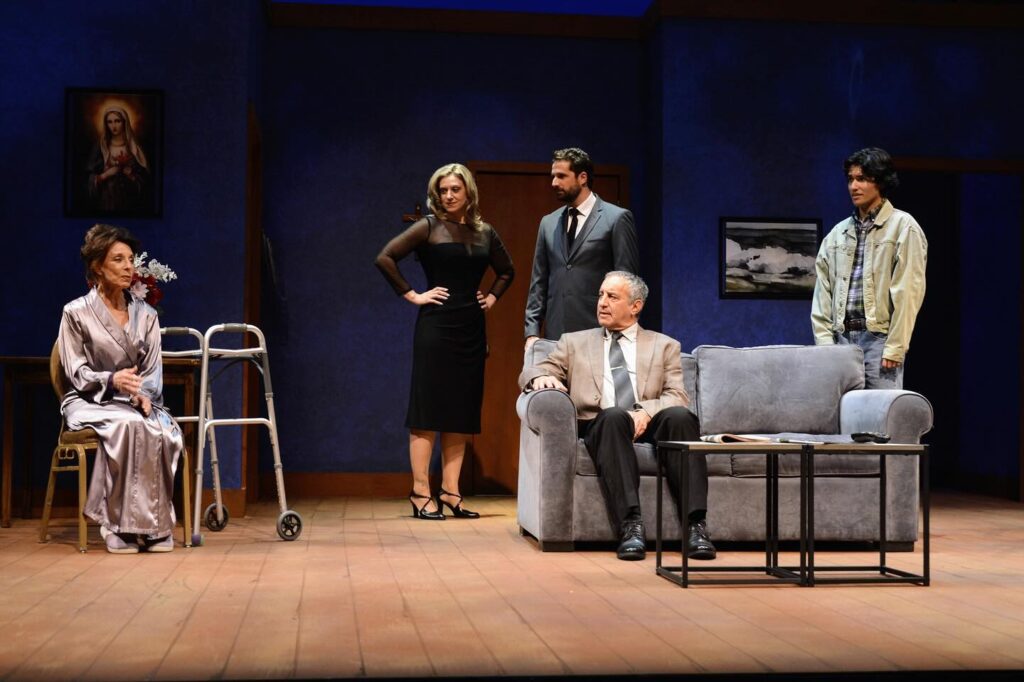
Theater often allows us to examine our own moral or ethical principles when a playwright contrives a situation in which a group of disparate characters come together, and we are allowed to judge their behaviors and actions. In this case, the setting is a sitting room in a Catholic hospital suite outside a room where an elderly woman has been in a car accident and is severely injured. She has been put in a medically induced coma, and her doctor is monitoring her progress while waiting for more developments.
Doctor Rachel (Anna Van Valin) angrily takes a phone call from her ex-fiance David (Elias Scoufaras), who appears to be trying to see Rachel, and she is rejecting his overtures. Klaus (Bruce Nozick), the hospital’s volunteer priest, stops by the waiting room, and he and Rachel start a dialogue that continues throughout the play even as other events transpire.
While the conversation begins in a lighter vein, it soon evolves into more personal revelations. We learn that David has advised Rachel to stop enabling her well loved but flawed younger brother. She takes his advice, her brother commits suicide, and all of the guilt and remorse causes their breakup. We also learn that Klaus has a past centering around his infantry service in WWII in Warsaw. He reveals a relationship with a woman and a gunshot wound that intrigues Rachel.
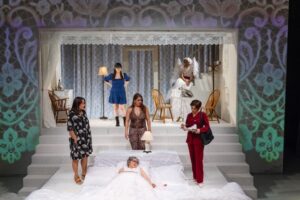
Interspersed among these stories, Krystyna (Suzanne Ford), the comatose woman, appears as if in a dream answering questions by a doctor (also played by Valin) that reveal her past life in Warsaw during that war. All these elements begin to hint of fate bringing these people together.
Ford delivers a fully realized and nuanced portrait of Krystyna with humor and warmth. Van Valin portrays a troubled woman who is coping with her regrets, and Nozick empathizes with her but adds depth to his own story. Scoufaras adds heightened emotion as David arrives to plead his case, and his distress is palpable.
Playwright Paul Webb throws in for good measure Nicholas (Spencer Del Carmen), the driver of the vehicle, who has injured Krystyna, and he visits her after she has awakened. It is at this point where all of the storylines veer together improbably, and Webb tidies up the loose ends with an overly romantic denouement.
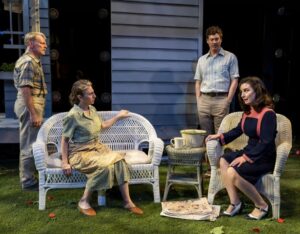
Director caryn desai moves the action swiftly along, handling the scene changes neatly. Destiny Manewal’s set design sets up locations where dream sequences can take place and interactions among the characters are believable. Lighting by Donna Ruzika is effective and sound by Hunter Moody is an integral part of the storyline. Kim DeShazo’s costumes add to the production, particularly for Ford’s character.
Though the anger and emotional heft of the play is handled by Valin and Scoufaras, the moments when Ford recalls her life are the most satisfying of the play. Though the issues ostensibly are resolved, there is a lingering doubt that the characters are out of the woods yet, and there may be more work to be done for them to move forward.